
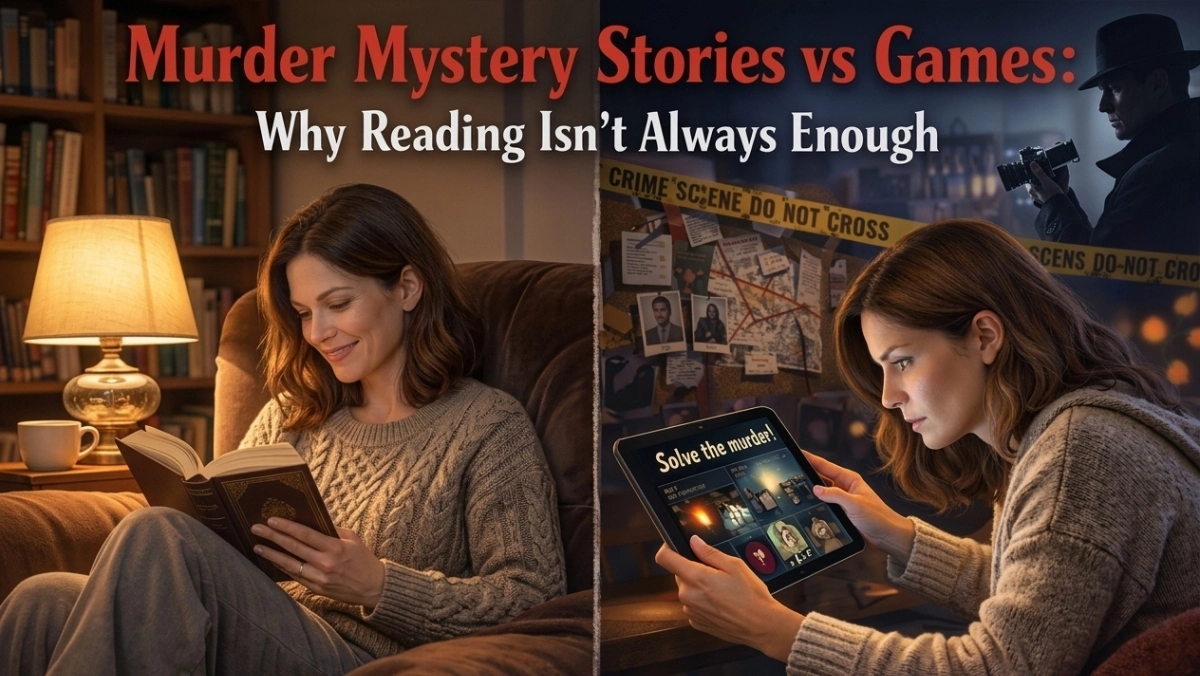
Murder Mystery Stories vs Games: Why Reading Isn’t Always Enough
If you’re the kind of person who loves mysteries, you already know the feeling:
- You’re halfway through a book or episode, and you have a theory
- You spot inconsistencies
- You notice things the main character hasn’t yet
- You spot the foreshadowing
And for a moment, it feels like you’re solving it. But then the story keeps moving—with or without you.
That’s the limitation of even the best murder mystery stories: They let you think, but not participate.
The Illusion of Solving vs Actually Solving
Mystery stories are designed to feel interactive. They give you:
- Clues spaced out just enough to keep you guessing
- Red herrings to challenge your assumptions
- Characters that invite suspicion
But underneath all of that, the structure is fixed. There is:
- One path
- One sequence of reveals
- One correct timing for every discovery
You’re not uncovering the mystery. You’re experiencing it at the pace the story allows.
Why This Feels More Like Real Investigation
Real investigations aren’t clean. They don’t unfold in a perfectly satisfying order. They don’t highlight what matters most. They don’t tell you when you’re close.
And they don’t wrap up neatly in 2 hours.
You have to:
- Decide what’s worth your attention
- Revisit information with new context
- Sit with uncertainty longer than you’d like
A well-designed murder mystery game mirrors that.
Not by making things harder for the sake of it, but by removing the safety net that stories naturally provide.
The Missing Layer in Most Mystery Experiences
Here’s what most people don’t realize until they try both: The difference isn’t just story vs game; it’s consumption vs ownership.
When you read a mystery:
- The story belongs to the author
- The pacing belongs to the structure
- The conclusion belongs to the narrative
When you play a mystery:
- The experience belongs to you
- The interpretation is yours
- The conclusion feels earned—not revealed
That shift is subtle, but it’s what makes the experience stick.
When Story Still Matters (And Why It Shouldn’t Disappear)
This is where some games fall short. They focus so much on mechanics that they lose what made mystery stories compelling in the first place:
- Strong characters
- Emotional stakes
- A world that feels connected
Without that, it becomes a puzzle, not a story. And puzzles don’t stay with you the same way.
The Sweet Spot: Where Story and Game Actually Work Together
The best experiences don’t replace storytelling—they build on it. They give you:
- Characters you recognize and follow over time
- A plot that evolves beyond a single case
- Details that gain new meaning the deeper you go
But instead of handing you the narrative, they let you assemble it yourself.
That’s what turns a mystery into something you don’t just remember,
but something you felt part of.
A Different Way to Experience a Mystery
If you’ve ever wanted more time with certain characters; felt like you could’ve solved it faster (or differently); or wished the story didn’t end when the case did; then you’re already looking for something beyond a traditional story.
Death & the Rosa Theatre is built around that idea. It doesn’t just present a mystery—it lets you move through it:
- Following characters across connected cases
- Reinterpreting information as new details emerge
- Experiencing the story as something you actively uncover
You can take it at your own pace, revisit details, and approach it like:
- A deep-dive investigation
- Or a mystery novel where you’re stepping inside
You Don’t Outgrow Mystery Stories—You Go Deeper
This isn’t about replacing books, shows, or podcasts. It’s about what happens after you’ve experienced enough of them. At some point, watching someone else solve the mystery just isn’t as satisfying as doing it yourself.
And once you’ve experienced that shift, it’s hard to go back.