
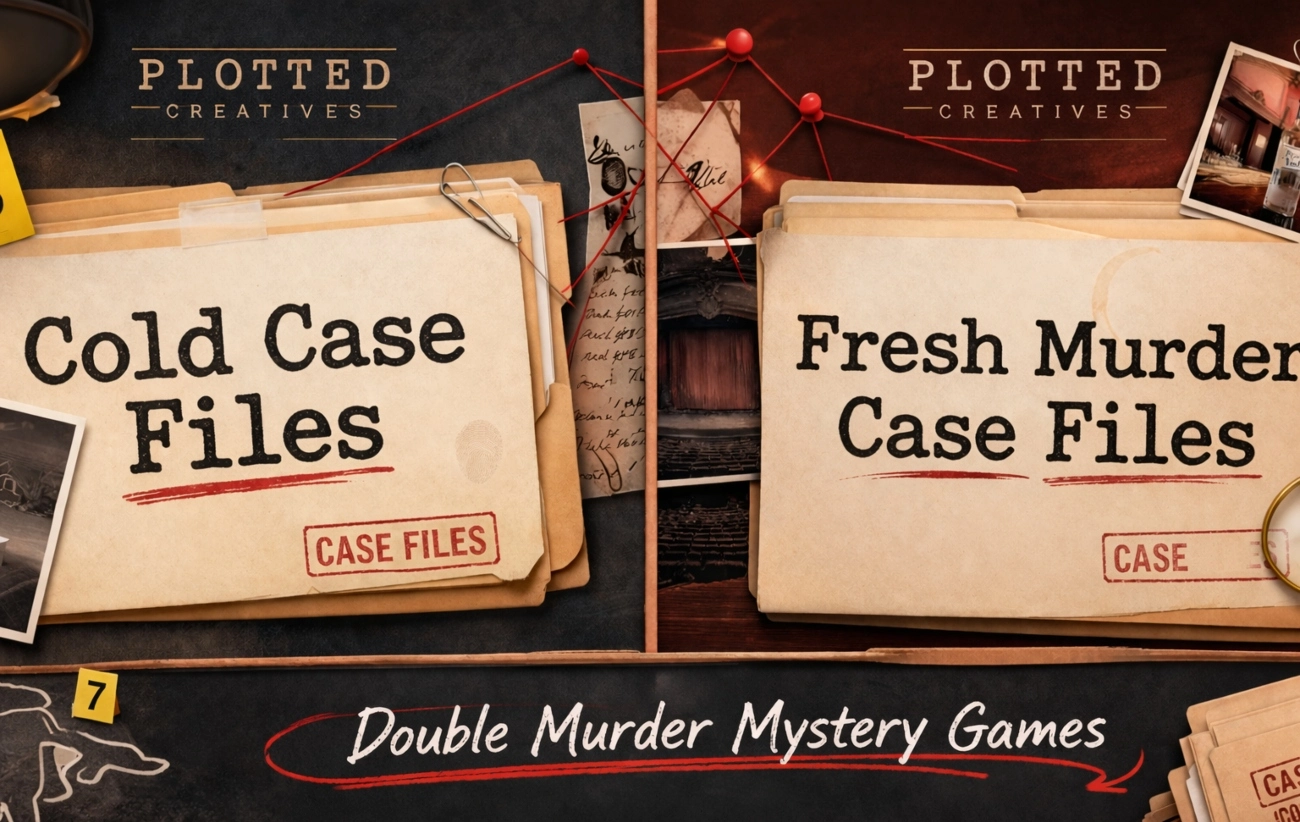
Solve Two Cases at Once: Why Double Murder Mystery Games Are the Ultimate Challenge
If you’ve ever finished a murder mystery game and thought, “That was fun… but I saw it coming,” you’re not alone.
Traditional games often follow a single path: one victim, one timeline, one solution.
But what if the mystery didn’t stop there?
What if solving one case was only half the story?
Welcome to the world of the double murder mystery game—a completely different level of immersive storytelling where nothing is as simple as it seems.
What Is a Double Murder Mystery Game?
A murder mystery game with multiple cases takes the classic format and doubles it—literally.
Instead of focusing on one crime, you’re solving two, but not the typical single-cases-to-solve bundle. This one involves:
- A cold case
- A fresh murder
On the surface, they may seem different; however, as you dig deeper, something shifts.
Clues begin to overlap.
Names repeat.
Details that felt insignificant suddenly matter because the cases are connected.
That’s where the magic happens.
Why Single-Case Games Start to Feel Predictable
Don’t misunderstand me. I’m not diminishing anyone else’s business. I know the blood and sweat put into these games.
But once you’ve played a few traditional mystery games, you start to recognize the patterns:
- The red herring
- The suspicious character who’s too suspicious
- The “twist” you saw coming
Single-case games are fun, but they’re often linear. You’re moving forward in a straight line toward one conclusion.
A double murder mystery game breaks that structure completely.
Instead of one line, you’re navigating:
- Two timelines
- Two investigations
- And hidden connections tying them together
This creates uncertainty in the best way possible. You can’t rely on patterns because there are twice as many moving pieces and layers.
How Layered Storytelling Pulls You In Deeper
The real power of a double-case format is layered storytelling.
You’re not just collecting clues. You’re building connections across timelines.
In experiences like Death at the Rosa Theatre, players move between:
- Archived interviews and evidence from four years earlier
- New witness statements and forensic reports from the fresh murder
- Personal details that evolve—or contradict—over time
As you work through both cases, your brain starts doing something different:
- Comparing timelines
- Spotting inconsistencies
- Re-evaluating earlier assumptions
And suddenly, you’re not just solving a mystery…
You’re reconstructing an entire story across years of events.
Bigger Mysteries = Bigger “Aha” Moments
Here’s the biggest difference players notice: The payoff is exponentially better.
In a single-case game, the “aha” moment is:
“Oh, it was them.”
In a double murder mystery game, it’s more like: “Wait… THAT connects to THIS… which means THEY…”
You’re not just identifying a culprit. You’re uncovering:
- Motives that span years
- Secrets that were hidden in plain sight
- Relationships you didn’t fully understand at first
Those layered realizations create a much more satisfying and memorable experience.
Who Double Murder Mystery Games Are Perfect For
This type of game isn’t about making things harder—it’s about making them richer.
If you enjoy:
- True crime documentaries where past and present intertwine
- Puzzle-solving that requires connecting multiple threads
- Story-driven experiences with depth and detail
- Feeling like a real investigator, not just a player
…then a murder mystery game with multiple cases is exactly your kind of challenge.
And despite the added layers, these games are designed to guide you step-by-step, so you’re never overwhelmed, just intrigued.
The Future of Murder Mystery Games
The double-case format is a shift in how mystery games are experienced.
Instead of handing you a single puzzle, it gives you a world to explore.
Instead of one story, it gives you two and asks you to uncover how they collide.
If you’re ready for something more immersive, more layered, and far less predictable, you can explore the full experience here: Death & the Rosa Theatre
Ready for the Experience?
Anyone can follow clues. But solving two interconnected cases at once?
That takes real detective work.
And once you’ve experienced it, it’s hard to go back to anything less.